If I asked most trades business owners why they lost a job, I’d usually hear the same answer.
“The customer went with somebody cheaper.”
Sometimes that’s true. But after working with trades businesses for 10+ years, I’ve seen plenty of examples where the cheapest quote didn’t win. I’ve also seen businesses charging significantly more than their competitors consistently secure better projects. I have gone for more expensive quotes myself, purely based on how I felt about the company quoting the work. They built trust, demonstrated their expertise, and this allowed me to make an easy decision.
Think about the experience from the customer’s perspective. They’ve probably invited three or four companies round to look at the work/project. Everyone seemed knowledgeable. Everyone sounded confident and said they could do a good job.
Then the quotes start arriving:
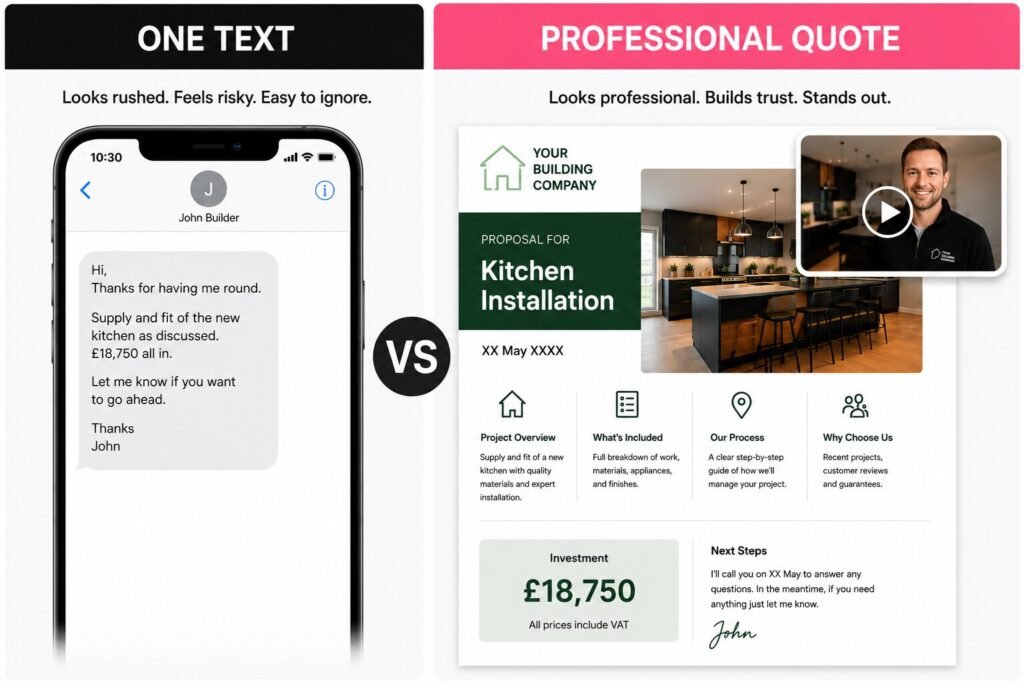
- One arrives as a text message with a price.
- Another arrives as a basic PDF/Word Document with very little detail.
- A third arrives with a professionally branded proposal, examples of similar work, customer reviews and a short video from the person you’ve been dealing with, explaining exactly what’s included.
At that point, the customer isn’t just comparing prices anymore. They’re deciding who feels like the safest pair of hands, and that’s where many trades businesses unknowingly lose work. Always blaming it on the price is an easy excuse.
Listen, I’m not dismissing the fact that often, these things can come down to price. But why not try to improve your chances!
The Follow-Up Is Part Of The Sale
A lot of trades businesses treat the quote as the finish line. The site visit is done, the measurements have been taken, and the price has been worked out. You or your team send over the quote, and attention moves to the next enquiry (or back to the tools).
The problem is that the customer is only just starting their decision-making process. They’re discussing the project with their partner and comparing options. There’s mutiple factors, but they’re now weighing up costs and working out who they trust the most.
If your follow-up consists of a one-line email and a PDF attachment, you’re leaving a lot to chance, as mentioned above.
The tradesmen winning the best projects are often creating confidence throughout the process, not just during the initial visit.

Presentation Matters…
Most customers aren’t construction experts. They don’t know whether one builder’s specification is technically better than another. They don’t know whether one roofer has allowed for a better underlay system, or whether one electrician has recommended a higher-quality consumer unit.
What they can judge is how the business makes them feel throughout the buying process.
When a homeowner is considering spending £15,000 on a new roof, £30,000 on an extension or £100,000 on a renovation, they’re making a decision based largely on trust. In many cases, they simply don’t have the technical knowledge to compare every detail of each quote.
Instead, they look for signals:
- How quickly did you respond to the enquiry?
- Did you turn up when you said you would?
- Was the quote clear and easy to understand?
- Did the proposal answer the questions they were already thinking about?
- Did the business feel organised?
These things might seem small, but together they create confidence.
The construction industry has a trust problem. Homeowners hear horror stories about builders disappearing halfway through projects, costs spiralling out of control and poor workmanship. It’s the reality many customers have in the back of their minds when they’re comparing quotes. Unfortunately, reputable tradesmen like yourself get tarnished with the same brush as consumers read articles that quote “Nationally, unscrupulous traders cost homeowners about £1.4bn a year“.
That’s why organisations such as the Federation of Master Builders place such a strong focus on testimonials, previous work, references and professionalism throughout the buying process. Homeowners are actively looking for reassurance before making a huge financial decision.
Imagine two businesses quoting for the same £50,000 extension.
1. The first sends over a one-page PDF with a total price and a brief description of the work.
2. The second sends a professionally branded proposal that includes a project summary, examples of similar work, customer reviews from like-for-like projects, a breakdown of the process, estimated timescales and a short video explaining the quote.
- Neither company has changed the actual work being offered.
- Neither company has changed the materials.
- Neither company has reduced their price.
Yet one immediately feels like a safer choice for the homeowner.
It matters because people don’t always buy the cheapest option. In fact, when the value of a project increases, customers often become more risk-averse. They’re not looking for the lowest number on the page. They’re looking for the contractor they trust to deliver the highest quality result without problems.
A well-presented proposal helps remove uncertainty. It answers questions before they’re asked, demonstrates attention to detail and shows that you’ve thought the project through properly.
More importantly, it positions you differently from competitors who are still sending basic estimates by email or text message.
This is where many trades businesses accidentally end up competing on price. If every quote looks similar, the customer has very little to compare beyond cost. When one business provides a significantly better experience, the conversation shifts away from price alone and towards trust, professionalism and confidence.
That’s often the difference between being viewed as “another quote” and being viewed as the company the customer actually wants to work with.
What a Modern Sales Process For Tradesmen Looks Like
We know that homeowners won’t decide whether to spend £10,000, £30,000 or £100,000 with a company based on a single interaction.
The decision is built over multiple touchpoints with your brand and your team. The initial enquiry, the first phone call, the site visit, the proposal, and the follow-up all contribute to a potential customer’s overall impression. That’s why the tradesmen consistently winning projects rarely rely on a simple enquiry > site visit > quote process.
Let’s look at a professional, structured experience that builds confidence in your sales process.
Initial Enquiry
When an enquiry arrives, the customer’s first question is usually:
“Have these people actually received my message?”
An automated response can answer that immediately while also introducing the business properly.
Rather than sending a generic confirmation email, this is an opportunity to explain what happens next, showcase examples of recent work and introduce the person who will be handling the enquiry.
A simple message cadence such as:
- Text message:
- Thank you for your enquiry text. Guiding the lead to check their email for more information.
THEN
- Welcome Email:
- Thank them for the enquiry.
- Intro them to a human: who’s going to be following up, and what experience do they have? (include an image as a bonus)
- Links to resources (blogs like this), case studies, and reviews.
Instantly, this feels more professional than 95% of other businesses they’ve enquired with.
It also sets expectations, which removes uncertainty/anxiety and reduces the chance of the customer continuing their search elsewhere.
Simple, and easy to do, and I bet you’re saying to yourself: “Yep, we should be doing this.
The Discovery Call
Before arranging a site visit, many successful businesses spend 10-15 minutes on the phone understanding the project in more detail.
This conversation isn’t about selling, it’s about learning. If you push too hard, your leads can smell what we call commission breath and naturally lose trust.
- What type of project is it?
- What timescales are involved?
- Who is involved in the decision-making process?
- Have they already received other quotes?
- Are there any concerns or challenges that need to be addressed?
By the time the site visit takes place, both parties have a much clearer understanding of whether the project is a good fit.
This is stuff we assume you’re already doing, but for those that aren’t, or new tradies – we hope that’s useful.
The Site Visit
Most trades businesses focus on measurements, specifications and technical discussions during the site visit. Which are the core requirements, obviously.
But customers are also paying attention elsewhere, too.
They’re seeing whether you arrive on time, whether you listen properly and whether they feel comfortable having you in their home.
The technical side matters, but so does the experience, warmth, and punctuality.
The Proposal
Once the project has been assessed, the proposal becomes far more than a price.
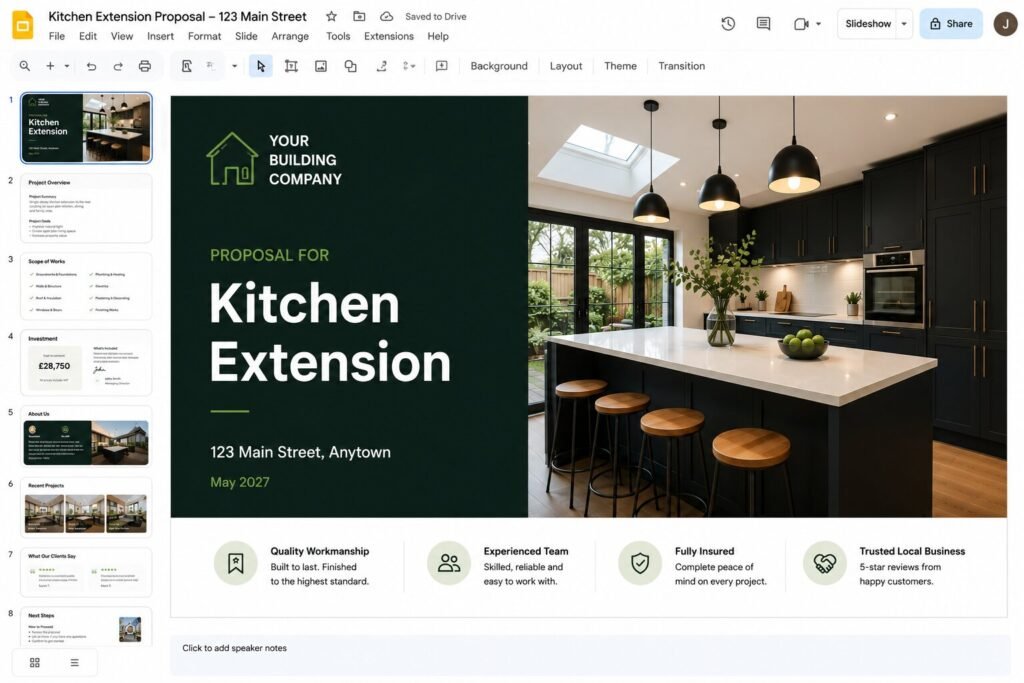
A well-structured proposal helps the customer understand exactly what is included, what the process looks like and what working with your company will be like if they decide to move forward.
Depending on the project, this could include examples of similar work (before and afters), project timelines, customer testimonials, guarantees, payment schedules and answers to common questions (include those raised in the discovery phase for a personalised touch).
The aim here isn’t to create a longer document, but to remove uncertainty and build trust. You’ll also be standing out against your competitors.
There are some tools out there that can help with this too…
Online solutions such as Better Proposals, Qwilr and Job Logic are available, and also come with other tools to help run your biz.
But having a template in Canva, or Google Slides can easily be edited for each job, and gives you much more flex over the style. If you’d like us to make you professional templates for quotes or sales processes, get in touch to discuss!
The Video Walkthrough
One of the simplest improvements any trades business can make is recording a short video to accompany the proposal – it instantly adds humanisation to your outreach, which is a huge trust builder.
Using a tool such as Loom or Vidyard you can spend two or three minutes talking through the quote and highlighting important personalised information.
For example, you might explain why you’ve recommended a particular solution, clarify assumptions made during pricing or answer questions that were discussed during the site visit.
Whether its a residential or commercial lead, they’ll appreciate the personal touch!

The Follow-Up
This is the stage where a lot of good leads can drift away. Not because the customer hated the proposal, and not always because another company came in cheaper. More often, the project simply drops down the priority list. Work gets busy, family life takes over, and the quote that felt important on Tuesday ends up buried in an inbox by Friday.
That’s why your follow-up needs to be treated as an important part of the sales process rather than an afterthought. The goal isn’t to pester them until they reply but trying to stay visible and answer questions whilst continuing to build confidence.
A simple follow-up sequence might look something like this.
Three days after sending the proposal: Short email or WhatsApp message checking they’ve received everything and asking whether there’s anything that needs clarifying. It’s just a gentle nudge (no hard selling) that shows you’re organised and available. A message such as “Just wanted to make sure the proposal came through okay and see if there’s anything you’d like me to run through in more detail” this feels helpful rather than pushy.
A week later: Send something that adds value rather than simply asking whether they’ve made a decision. This could be a case study from a similar job, a few before-and-after photos, or a short explanation of how you typically manage projects like theirs. If you’re quoting for a new kitchen, for example, you might send over photos from a recent install with a short note explaining how long it took, what the biggest challenge was and how the project was managed from start to finish (cherry on top if you have a testimonial).
Ten to fourteen days after the proposal: This is often a good point to reintroduce the human side of the business again. That could mean sending a short note introducing the project manager they’d be dealing with if the job goes ahead, or a quick video answering a question that came up during a site visit. The point is to keep reducing uncertainty.
After two/three weeks: Send a final follow-up that gives the lead an easy next step without making them feel cornered. This could be an invitation to jump on a call, an offer to tweak the scope if they want to phase the project, further finance options, or simply a message saying you’re happy to answer any final questions before they make a decision.
The important thing is that each follow-up has a purpose and that’s a completely different approach to sending the same “just chasing this up” email three times.
A good follow-up process should feel calm, useful and professional. When looking back through the thread, leads will see a trademen that communicates well, follows through and makes the buying process easier. It will make the whole experience feel organised and keep your business front of mind without being overbearing.
That’s often the difference between a quote that gets forgotten and a quote that turns into a signed job.
Are you getting enough enquiries?
Are you struggling to get consistent enquiries? We can help, whether it’s improving your search precence in Google, running cost effective ads that give you a return on your ad spend, or even sitting in your business to provide fractional marketing support (vs hiring a marketer in-house) – we can help.
If you could do with some help – give me a call, or get in touch here.

Some Nice Things From Clients…
Trade Pixels made the whole process simple and stress-free, guiding us from the first ideas through to a finished brand and site that we’re proud to show off. The result looks professional, reflects the quality of our work, and we’re very happy with the final result!”

I can’t recommend Trade Pixels enough. They were a pleasure to work with, always responsive and they delivered above and beyond my expectations. If you’re a local tradesperson or business owner, looking to give digital marketing a go… these are your guys!

Enjoyed working with Ben and the Trade Pixels team on my new website. Since launch we’ve seen more trffic, better rankings, and ultimately more leads coming through the website. I would highly reccomend them for your next digital marketing campaign.