Let’s be honest. Most Meta ad campaigns are a bit sh*t.
Not because Facebook and Instagram don’t work, or targeting is broken, and definitely not because “paid social is dead” like some marketers love telling everyone every few years. The problem is much simpler.
Most trades spend all their time thinking about the advert and almost none thinking about what happens after someone clicks it.
We see it all the time… A trades business spends £1,000 or £2,000 a month on ads, sends traffic to a generic website page, collects a handful of enquiries and then has no real idea which campaigns generated them. Six months later, they’re convinced Meta doesn’t work.
In reality, the advert is only one part of the process.
The builders, roofers, and electricians getting consistent results from Meta have built a complete lead gen system around their ads. Every stage has a job to do. The ad grabs attention, the landing page continues the conversation, the form qualifies the lead, and the tracking in the background shows us what’s actually generating revenue (the tracking is often overlooked, but it’s one of the most crucial parts).
At Trade Pixels, the funnels producing the best results generally follow a straightforward path:
Meta Ad > Dedicated Landing Page > Interactive Form > CRM > Follow-Up > Revenue Tracking
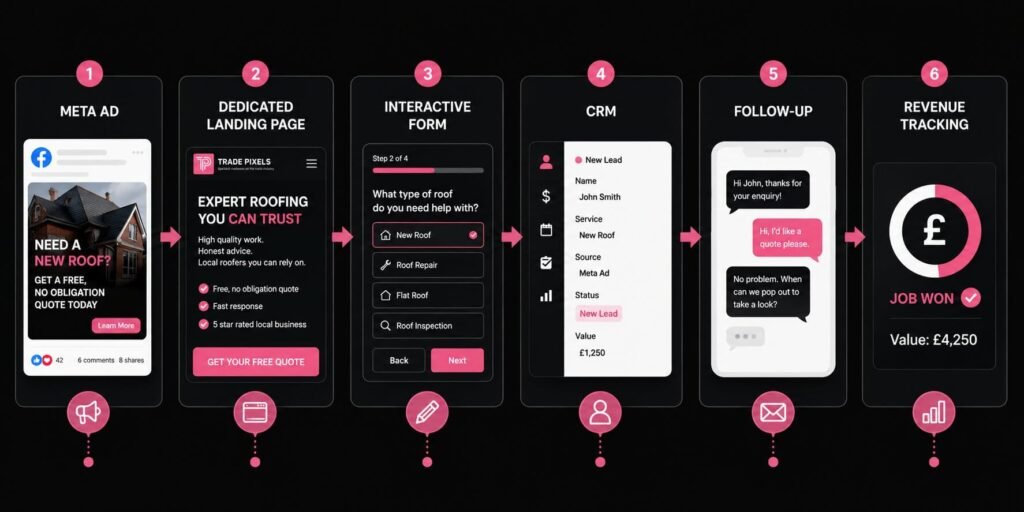
We like to keep things simple – there’s nothing complicated here.
But when every stage is working together, lead quality improves, conversion rates increase and you finally get clear visibility on where your enquiries are coming from.
Let’s look at what makes the biggest difference.
Great Campaigns Start With Great Creative
Most tradesmen know they need to run ads. If you want to drive leads right now, ads are the key, whether it’s search or social.
Far fewer understand that the creative is often the biggest factor in whether a campaign succeeds or fails.
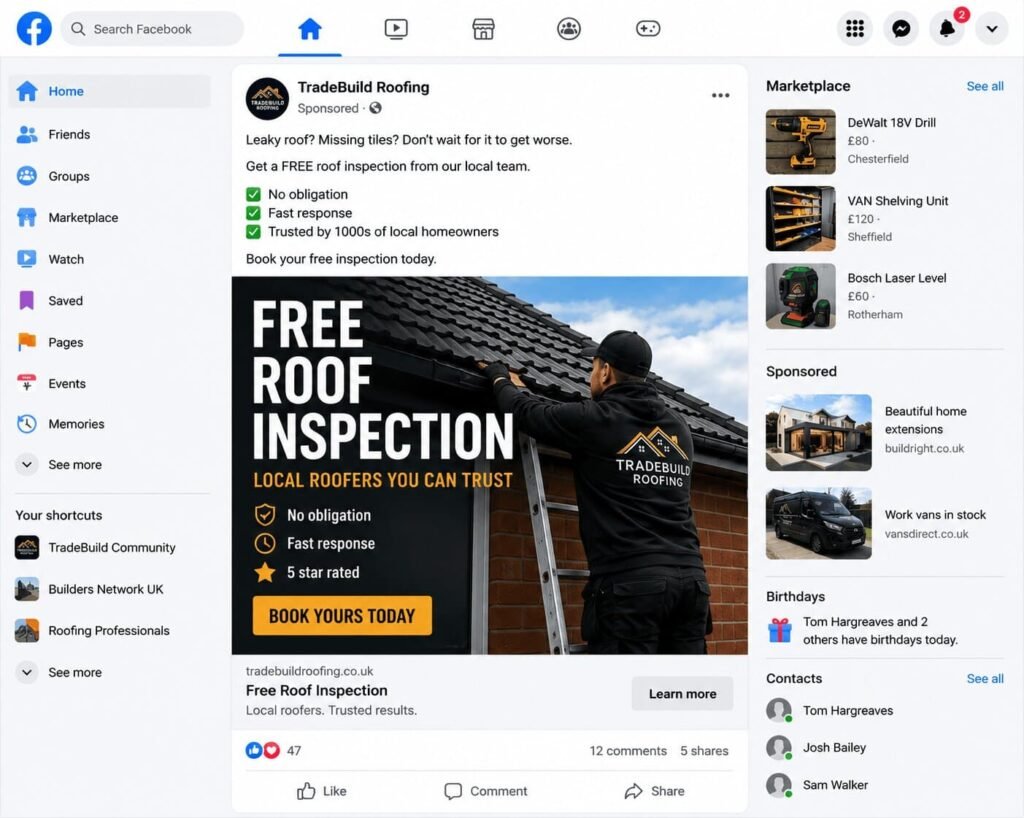
Meta’s targeting has become increasingly automated over the years. The platform is very good at finding the right people if you give it enough data. What it can’t do is make boring adverts interesting. You’re competing against family photos, football clips, holiday videos and whatever argument is currently kicking off in the comments section. Nobody opens Facebook hoping to see an advert from a local builder, roofer or plumber.
You need something that earns attention, and that’s why real project content almost always outperforms polished graphics and stock photography.
A before-and-after transformation. A video walkthrough of a finished project. Drone footage of a roof replacement. A homeowner explaining what was done and why they were happy with the result. Your team on screen, showing the human side of your business, and who your customers are going to be speaking to, and letting into their home or business. These are the things that stop people scrolling.
The other mistake we see regularly is businesses focusing too heavily on what they do rather than the outcome they provide.
Customers don’t really care about your process. I see it all the time:
An ad with a tradesman team saying: “Our process is site/home visit, simple quote, job starts”. Okay great, the same as 100% of all trades businesses
Potential customers care about the result, and the results of your previous customers. Not just the work, but how your team came across, your aftercare, your responsiveness. There are loads of horror stories people here about trades, and your ads should focus on demonstrating how you’re different, and if you have proof (reviews and testimonials) to back it up, you’re on to a winner with your ads.
A homeowner isn’t looking for “professional roofing services”. They’re looking for a roof that stops leaking and will last for the next 50 years. They’re looking for reassurance that you can do a good job. They’re looking for a company they trust enough to invite into their home.
The best adverts focus on that outcome first and explain the service second.
Stop Sending Paid Traffic To Your Homepage
If there’s one thing that consistently damages campaign performance, it’s this. A potential customer clicks an advert about a specific service and lands on a generic homepage. Suddenly, they’re faced with multiple services, navigation menus, company information, blog posts and half a dozen different directions they can go next.
Dedicated landing pages convert roughly 2-3 times better than homepages The median dedicated landing page converts at 6.6%, while typical website pages convert at around 2-3%. In practical terms, sending paid social media traffic from your ads to a focused landing page can generate more than double the enquiries from the same ad spend.
Most don’t choose any of them and leave, and when they do, that’s just cost you money…
A landing page should continue the conversation started by the advert. If your ad promotes a free roof survey, the landing page should be entirely focused on booking that survey. If your ad promotes a kitchen renovation service, every element on the page should reinforce that message.
When the advert and landing page feel connected, conversion rates improve. When people feel like they’ve landed somewhere unexpected, they lose confidence and start looking elsewhere. Good landing pages are usually much simpler than people expect. They don’t try to explain every service the business offers. They don’t overwhelm visitors with options.
They focus on one goal and make the next step obvious.
Trust also plays a huge role here. People are often making enquiries about projects worth thousands(£). They’re naturally hesitant. Reviews, testimonials, project galleries, guarantees and case studies all help reduce that hesitation and give people confidence to get in touch.
Interactive Forms Often Convert Better
Most contact forms haven’t changed in twenty years.
- Name.
- Phone number.
- Email.
- Message.
The problem is they don’t create much engagement and they rarely give you enough information to properly qualify a lead. That’s why we’ve increasingly moved towards interactive forms.
Rather than presenting a prospective customer with one large form, you guide them through a series of simple questions. What service do they need? What type of property is it? What’s the rough project budget? When are they hoping to start?
It feels more conversational and generally creates a better experience and it also helps in two important ways.
The first is lead quality. By collecting more information upfront, you can quickly identify which enquiries are a good fit and which probably aren’t. That saves time for both your business and the customer.
The second is sales efficiency.
When somebody submits an enquiry, your team already has useful context before picking up the phone. They know what the customer is looking for and can have a more productive conversation from the start. That’s particularly valuable for trades biz owners where time is already stretched between site visits, quoting and managing jobs.

Attribution Is The Bit Tradesmen Get Wrong
Attribution isn’t the most exciting topic in marketing. It’s also one of the most important. Okay, marketing jargon, so what is it?
Attribution is what connects the job you’ve just won back to the advert, campaign or marketing activity that generated it in the first place. It helps us understand what marketing activity is working, and your return on ad spend.
A lot of businesses know they’re generating enquiries. The problem is they don’t know exactly which campaigns, adverts or audiences are responsible for those enquiries. Without proper tracking, you’re making decisions based on assumptions, which is usually a tactic that will see you wasting budget in the long term. You know what they say – assumtions are the mother of all…
By sending conversion data directly from your website, forms or CRM back into Meta, you give the it a much clearer picture of what’s happening. That improves reporting accuracy and helps Meta optimise towards the people most likely to convert. Meta can then use that data, to get your ads infront of more people who are likely to convert.
If you’re running ads for traffic, when someone clicks your ad and goes to your website, Meta receives a positive signal saying “More of these people please”. This person may not be right, and has not filled out a form – yet Meta see’s this a good thing.
If we run an ad with form submission as the goal, everytime someone fills out your form, Meta receives that positive signal, but this time, it can now optimise for more people you want on your website, or landing page. We can also send back sales data to Meta to further optimise in the future.
We’d also recommend implementing proper UTM tracking across every campaign – you can use a tool like Google’s UTM URL Builder. It sounds boring, but it’s one of the easiest ways to understand exactly where enquiries are coming from once they enter your website and CRM.
More importantly, businesses need to stop measuring success purely by lead volume.
Generating 50 enquiries sounds great.
But if 40 of them are poor quality and never become paying customers, the number is largely irrelevant.
What matters is what happens after the lead arrives.
- How many became qualified opportunities?
- How many site visits were booked?
- How many quotes were sent?
- How many jobs were won?
- And ultimately, how much revenue was generated?
Those are the metrics that actually tell you whether your marketing is working.
Don’t Ignore What Happens After The Lead Comes In
You can build the best Meta funnel in the world.
You can have brilliant creative, a high-converting landing page, excellent tracking and a well-designed interactive form, but It won’t save poor follow-up process. We’ve seen businesses spend thousands generating enquiries and then take two or three days to call people back and by that point, the prospect has often spoken to somebody else.
The businesses that consistently win work tend to be the ones that respond quickly, stay organised and have a clear follow-up process.
- Marketing gets the lead.
- The sales process wins the job.
Both matter – so worth having a dedicated process in place to ensure that leads are responded to with speed.

What The Best Meta Funnels Have In Common
The businesses getting the strongest results from paid social aren’t relying on tricks, hacks or secret strategies. They’re usually doing the basics exceptionally well – if you’ve spoken with me on the phone, you’ll have heard me say this over and over again!
They create ads that showcase real work and real results. They send traffic to dedicated landing pages rather than generic website pages. They use easy, interactive forms that help qualify enquiries before the phone rings. They track what happens beyond the initial lead and they respond quickly when somebody gets in touch. None of that is complicated, it’s super simple.
When all those pieces work together, Meta becomes far more predictable. Instead of wondering whether your ads are working, you know exactly what’s generating enquiries, which campaigns are producing the best jobs and where your next opportunities are coming from. And that’s ultimately the goal.
We’re not focused on more clicks, more impressions.
We’re focused on more enquiries, better jobs and more profitable work closed in a simple, repeatable way.
Want some help? Give me a call, or get in touch here.

Some Nice Things From Clients…
Trade Pixels made the whole process simple and stress-free, guiding us from the first ideas through to a finished brand and site that we’re proud to show off. The result looks professional, reflects the quality of our work, and we’re very happy with the final result!”

I can’t recommend Trade Pixels enough. They were a pleasure to work with, always responsive and they delivered above and beyond my expectations. If you’re a local tradesperson or business owner, looking to give digital marketing a go… these are your guys!

Enjoyed working with Ben and the Trade Pixels team on my new website. Since launch we’ve seen more trffic, better rankings, and ultimately more leads coming through the website. I would highly reccomend them for your next digital marketing campaign.